
WHAT BAD BUNNY KNOWS THAT AMERICA STILL REFUSES TO SEE
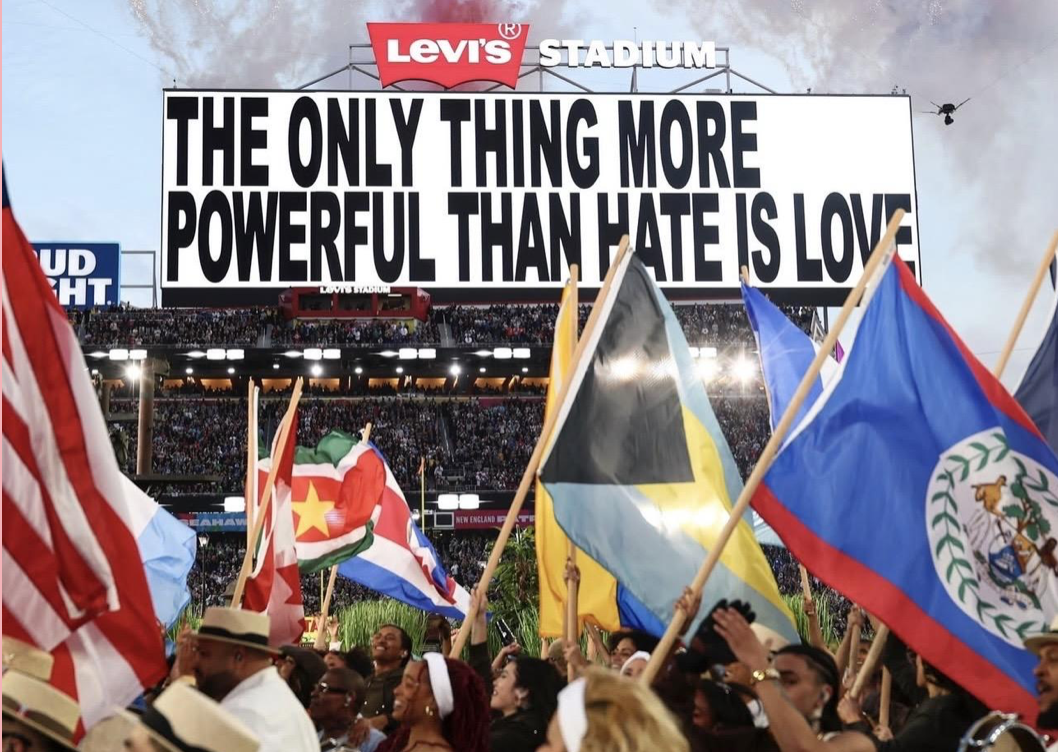
Bad Bunny’s Super Bowl halftime show today was loud, confrontational, and entirely normal.
And for America right now, that’s the point.
The show put:
Labour before performance
Belonging before branding
Community before spectacle
From the opening frames, the show centred migrant and working-class labour - the people whose work feeds, powers and sustains the US, yet whose humanity and culture are routinely flattened, erased, or criminalised in political discourse.
For decades, mainstream US media has tended to present Latinx culture in two ways: as an exoticised “fiesta” (tacos, tequila and afternoon naps), or simply not at all.
What Bad Bunny offered instead was everyday life - work, community, joy and risk - shown without translation or apology, and as a reflection of Latinx life within America.
Language did a lot of the heavy lifting here. Performing entirely in Spanish - no subtitles - Bad Bunny rejected the long-standing expectation that Latin (or any international) artists must translate themselves to be palatable to a Western market.
It quietly asserted that understanding is not a prerequisite for respect.
The only three words not spoken in Spanish? “God Bless America” - a line that landed with both irony and ownership.
And then there was joy - real, embodied, collective joy on the field, in the stands, and in living rooms across the world (including my own).
In communities shaped by precarity, joy is defiance.
This performance retired idea that marginalised people must perform suffering to be taken seriously. Instead, it celebrated itself.
One of the most powerful visual moments came with workers on power lines - a reminder that the lights don’t stay on without someone taking the risk. Essential labour is dangerous, racialised, and often migrant. These bodies are indispensable to the American economy and yet politically disposable, and that tension hummed quietly underneath the entire show.
In case you hadn’t cottoned on yet, the message sharpened further with the display of flags and the billboard reading: The only thing more powerful than hate is love.
In a moment of escalating anti-immigrant rhetoric and ICE raids, visibility itself becomes political. The coalition of flags, including the American flag, challenged the idea that “American” identity is singular or monolithic.
The celebrity cameos added another glorious layer. Artists like Ricky Martin, Lady Gaga and Cardi B represent different eras of access - from assimilation, to collaboration, to fluency.
Contrast that with images of Bad Bunny sitting alone at the Grammys due to security threats: this halftime show was the opposite - collective, joyful and protected.
Which makes the parallel attempt by Turning Point USA to stage an alt-right “halftime show” feel absurd (because they are absurd).
While one side tried to manufacture relevance, the other embodied it.
While one side clung to grievance, nostalgia and culture-war theatre, the other simply existed.
The Super Bowl is one of the most nationalist media events in the US. For a Spanish-speaking Caribbean artist to centre labour, language, joy and solidarity on that stage was a reminder that visibility is political when your existence is debated, and that sometimes presence is the most powerful protest you can make.
This piece first appeared in Excessive Consumption - a weekly dispatch on culture, branding, politics and whatever other modern internet brain rot the algorithm has emotionally assigned me that week.
Subscribers get every edition first. The archive opens later.