
BACK FOR THE HAT
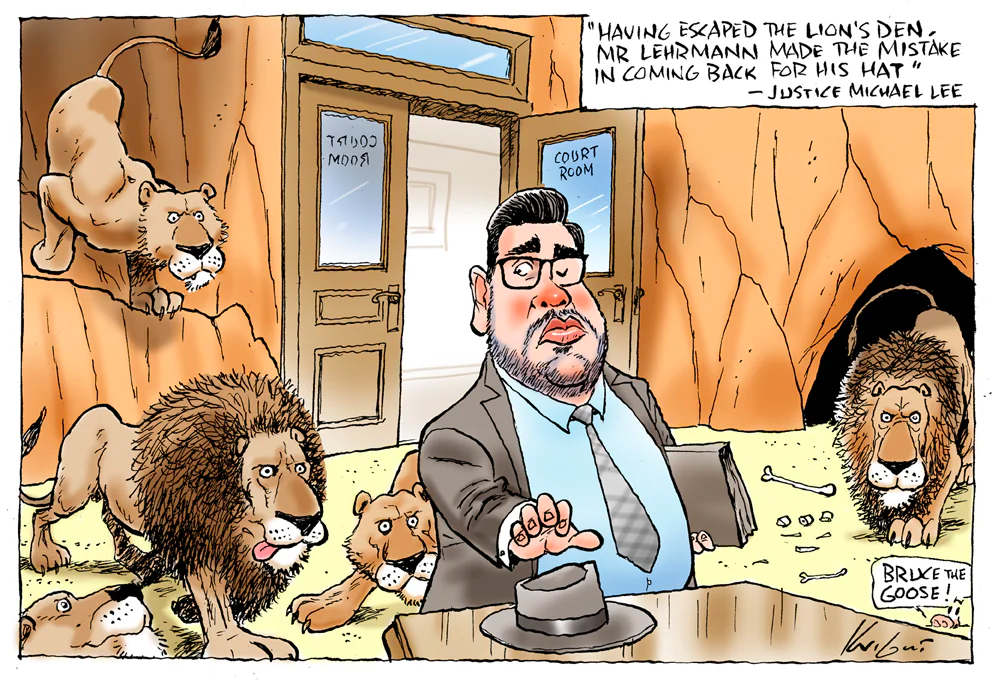
Image: Knight Cartoons
Whilst we've all been distracted by Bieber Fever 3.0, something far more curious (sinister? revolting?) has been playing out in the Australian court system.
Bruce Lehrmann (aka Brittany Higgins alleged rapist) has officially run out of road with his final attempt to appeal his defamation loss against Network 10 dismissed.
Ben Roberts-Smith, who also lost his defamation case against Nine Entertainment, has now been arrested and charged with war crimes following allegations first reported years ago.
Oh, and Lehrmann? He's back in the criminal system again - facing a further rape charge in Queensland. But that's a story for another day.
It's a very specific pattern that has played out in Australian courts over the last few years: two men, with two reputations under pressure, and two decisions to take it to defamation court.
And now, two outcomes that are less redemption arc and more spectacularly arrogant miscalculation.
We tend to talk about defamation cases like they're about truth. But what Lehrmann and Roberts-Smith have both learned is that they're actually about reputation management and narrative control, and more specifically: who gets to control it.
In Australia, defamation law forces media organisations to defend what they published - often by proving it is substantially true and that it was published on reasonable grounds.
Which turns the courtroom into something else entirely.
Not quite criminal, but more than hypothetical - and very, very public.
A trial by proxy, if you will.
Defamation trials drag the story from an article or a TV segment into a forum where evidence actually gets tested, witnesses actually get examined, and everything is put on the record.
It's essentially a bet, that the story can be beaten. An aggressive, arrogant, defensive choice to escalate.
Instead, both cases did the exact opposite of what they were supposed to do.
Both Lehrmann and Roberts-Smith ultimately lost their defamation cases and in doing so, shifted those allegations from headlines into findings that now carry both legal weight, and weight in the court of public opinion.
Instead of restoring their reputations, they cemented their ruin. Across timelines, group chats, podcasts and dinner tables.
They took allegations that could have remained contested in the public sphere and forced them to withstand scrutiny inside a courtroom. And once that happens, there's no spinning your way out of it.
The underlying assumption in both of these cases is the same:
That reputation is something you can strong-arm back into shape.
That you can outplay the system.
That if you push hard enough, the narrative will bend.
But that only works if the facts are on your side, and if they're not?
Then all you've done is take something that might have faded over time and cement it permanently. And while Lehrmann's earlier criminal proceedings collapsed, Roberts-Smith's situation has escalated - culminating in his arrest at Sydney Airport last week.
In Lehrmann's case specifically, the warning was there from the start.
Justice Michael Lee famously described his decision to pursue defamation after the collapse of his criminal trial as akin to returning to the “lion's den” only to then make the mistake of “going back for his hat.”
It's a line that's already become shorthand for the entire strategy. Because that's exactly what this was: a dumb arrogant silly decision to go back in.
Now - there IS a parallel universe version of this where neither case goes this far. If thier strategies had been to let the news cycle move on the damage may have been contained, not amplified.
Instead, both chose to escalate (because, men).
And in doing so they ensured that the very thing they were trying to shut down is now the very thing that defines them.
And you won't find much any sympathy for them here.
This piece first appeared in Excessive Consumption - a weekly dispatch on culture, branding, politics and whatever other modern internet brain rot the algorithm has emotionally assigned me that week.
Subscribers get every edition first. The archive opens later.