
DID THEY JUST MAKE COOL UN-COOL?
As a brand and marketing girly (with a double-major in sociology and politics 🤓), believe me when I say I love me some market research.
But this week? I think the American Psychological Association missed the mark when they published “Cool People" by Todd Pezzuti, PhD.
I’ve read skimmed the full 60-page paper, read the NYT article, nodded along with Pedestrian, and even took in The Guardian and The Times coverage - because I’m a certified data nerd and I’ll eat up anything that promises to decode charisma and explain the mechanics of social perception.
But even I must admit that trying to quantify cool is SO uncool.
And kind of missing the point. Because the version of cool it spits out? Too mainstream.
According to the study, the six traits that make someone universally “cool” are:
1. Extraverted
2. Adventurous
3. Open to experience
4. Autonomous
5. Powerful
6. Hedonistic
And like, yes - in theory. Of course, cool has always had a little danger to it (that’s part of the appeal), and it's sexy and adventurous and independent…. but like, is this the Seven Deadly Sins or are we trying to turn ‘cool’ into a personality framework?
It’s the academic equivalent of your Dad explaining a meme. Totally kills the vibe.
Also worth noting? The data for this study was collected between 2018 and 2022. Which, in terms of cultural currency, might as well be a lifetime ago. That’s pre(and mid)-Covid, pre-Tiger King, pre-Barbie, pre-Eras Tour, pre-Matty Healy, pre-BRAT, pre-"core" overload, pre-AI boom. Before TikTok swallowed pop culture whole and Twitter completely collapsed in an angry alpha-male heap.
Because here’s the thing: cool is context. What’s cool in Orange, NSW isn’t necessarily (read: is definitely not) what’s cool in Seoul. And what reads as cool in a Berlin gallery or a New York subway might not land in London, Sydney, or Timbucktoo.
It can't be boiled down to six key attributes because it shifts across geography, subculture, and time. And even then, it's in the eye of the beholder.
Cool isn't meant to be universal.
It’s rooted in counterculture - think 1960’s antiestablishment vibes, free love and political activism.
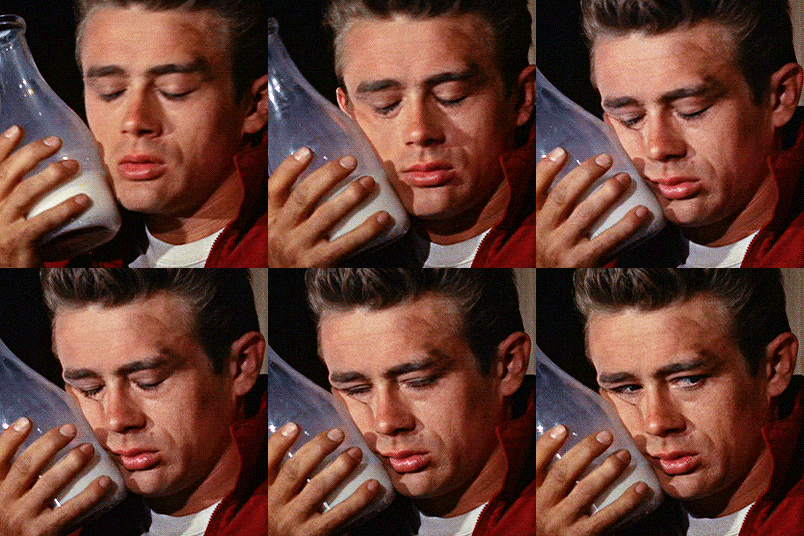
It’s subversive - undermining society from within a la James Dean in ‘Rebel Without A Cause’.
And, it’s disobedient - openly challenging authority and conservative norms with all the gusto of an Elvis Presley hip-shake or that Mick Jagger swagger.
But the global consensus this study claims to find actually flattens cool into a universal checklist that betrays the very thing that made it cool in the first place.
This study doesn’t account for those hyper-local, subcultural expressions of cool - the kind that bubble up from the margins, not the middle.
The study doesn’t leave room for the grit, the nuance, or the contradiction that makes someone truly cool.
You can't just check a box and be a confident extrovert with a rebellious streak to be called cool (in fact, we'll probably all laugh at you - like we do Jojo Siwa).
Cool is about context, timing, cultural codes and breaking the rules without trying too hard.
You just know it when you see it.
And by the time you’ve seen it? You’ve already missed it, babe.
This piece first appeared in Excessive Consumption - a weekly dispatch on culture, branding, politics and whatever other modern internet brain rot the algorithm has emotionally assigned me that week.
Subscribers get every edition first. The archive opens later.