
LITERALLY STANDING ON BUSINESS
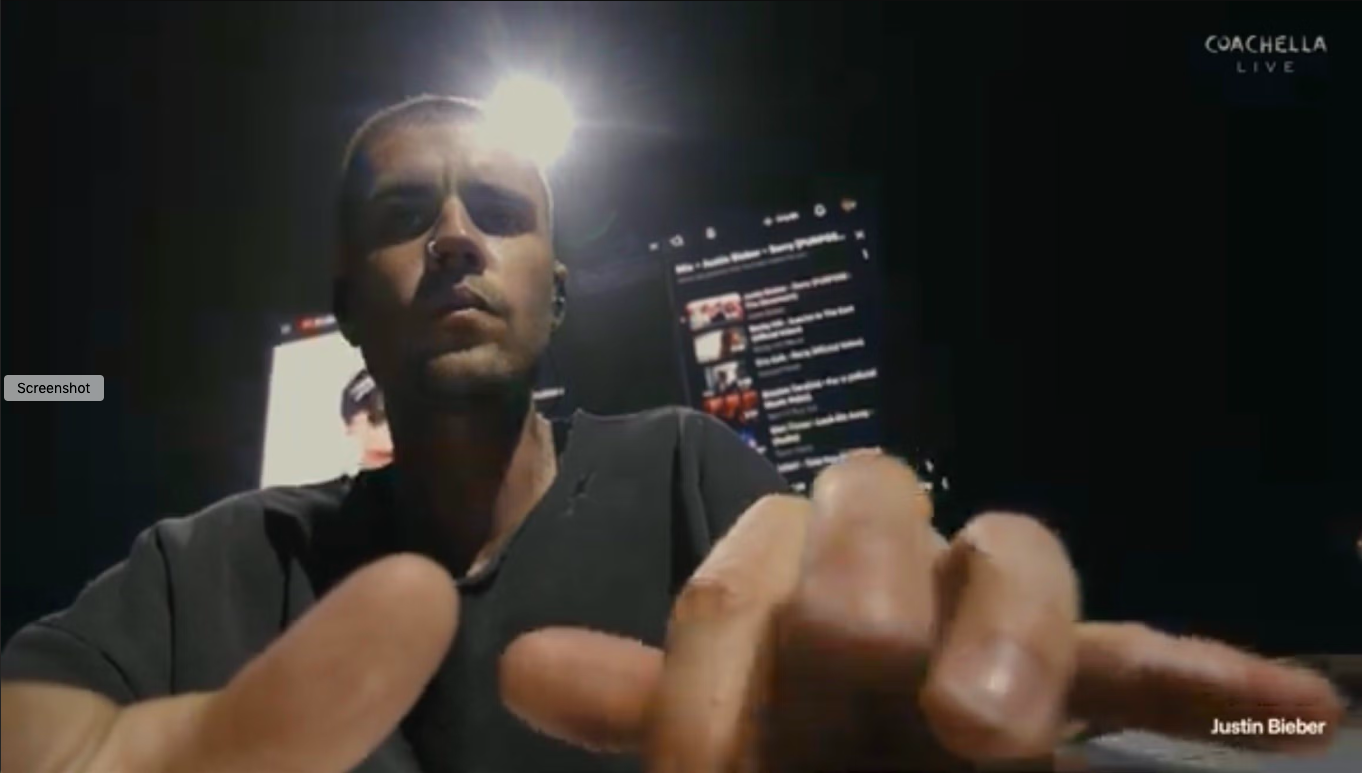
The internet is arguing about whether Justin Bieber's Coachella set was lazy or genius, but they're all asking the wrong question.
The performance itself was almost beside the point.
Yes, it was minimal. No dancers, no big numbers or overproduced set pieces, and zero attempt to outdo the version of him that filled arenas as a teenager.
And it worked.
Treating it as a lack of effort feels naive. Bieber stripped it back because doing more would have been disingenuous at this point in his career…not because he's forgotten how to dance.
But the YouTube bit is the part that's got most people talking. Just a laptop, a string of <30 second clips, a few iconic internet moments, and Bieber harmonising with his younger self.
Most people have landed on nostalgia as the explanation. And sure, it was a neat way to compress 20 years of music into 20 minutes.
But that's not the whole story.
Because if he'd wheeled out Baby with full choreography and a purple hoodie, it would have fallen flat. The song still absolutely slaps (obviously) but the cultural moment is long gone. You can't recreate the conditions that made that made Bieber Fever so contagious (in 2010 or in 2015).
So he didn't try.
Instead of performing the past, he reframed it, and he watched it back with us.
And the YouTube schtick was as emotional as it was essential.
In 2023, Bieber sold his back catalogue to Hipgnosis Songs Capital, backed by Blackstone. Now, that doesn't stop him from performing those songs, but it does shift where the value of them sits. The money isn't in re-performing the hits for spectacle - it's in how those songs continue to circulate, stream, and live (both online and culturally).
So what Bieber did on that stage was equal parts pop performance and distribution design.
Playing clips through YouTube (Premium, no less), inside a festival that is literally broadcast on YouTube, while engaging with YouTube's live comment feed?
That isn't lazy. It's commercially sound.
The catalogue holders get renewed traffic.
The platform gets a cultural spike.
Coachella fulfils its streaming deal.
The fans get what they came for.
And Bieber gets to sit at the centre of it all without having to compete with his own back catalogue in the traditional sense.
That's not lazy. That's structurally precise.
But the most interesting part is how self-aware it all was.
The whole thing looked like the internet because that's where Bieber actually exists now - not on a stage, but in meme-ified digital fragments. Old clips, interviews, music video moments that are constantly resurfacing and forever recontextualised.
So instead of translating that into a traditional concert, he just…didn't.
He simply brought the format with him.
A laptop. A screen. A feedback loop between content and audience.
Not a performance for the internet - a performance as the internet. With the internet. On the internet. The internet, performing itself, live on stage.
That's not lazy. That's very, very meta.
And sure, the easy bait here is the gender argument. It's valid - but it's also a bit blunt in this context.
Would a female artist get away with doing less? Absolutely not.
But comparing Bieber to Sabrina Carpenter's headline set misses the nuance. They've built completely different contracts with their audiences. Carpenter has been escalating - getting bigger, sharper, and more “ambitious” by her own admission.
Bieber has spent years doing the opposite: less production, less polish, less output. More distance, more privacy, more control.
This was simply a continuation of that (albeit on one of the pop culture's biggest stages)
And today?
People love it. People hate it. People are writing essays (hi 👋) trying to decode it.
Which is, of course, the whole point.
The mistake is thinking this was a performance that succeeded or failed on its own terms without realising it was designed to travel - to be clipped, debated, dissected, reposted and replayed across the exact platforms it was built around.
So no, it wasn't lazy. Bieber was LITERALLY standing on business.
On music industry business. On festival economy business. On personal brand business. On the business of cultural capital.
It's the economy, stupid (God, I hope at least one person out there understands this reference🤞)
It was a performance that understood exactly where its own value sits now - and met it there.
Bloody can't wait to see what happens on Weekend Two! 🎡
This piece first appeared in Excessive Consumption - a weekly dispatch on culture, branding, politics and whatever other modern internet brain rot the algorithm has emotionally assigned me that week.
Subscribers get every edition first. The archive opens later.