
STATE OF PLAY: PART ONE
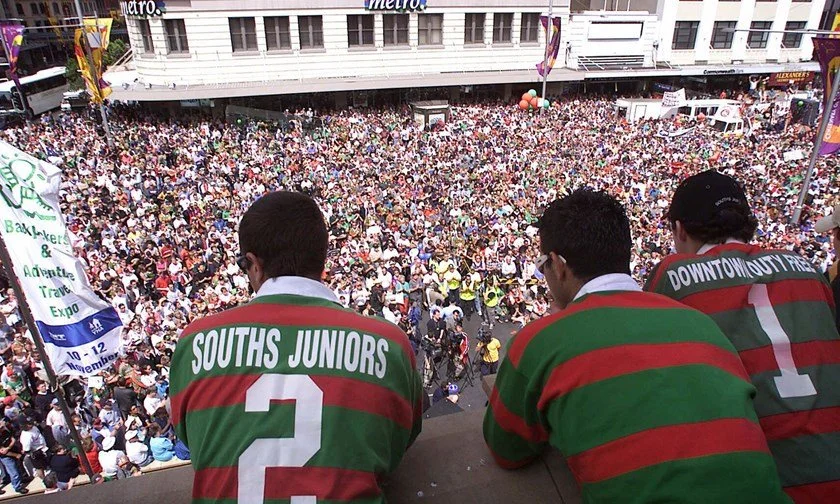
There are very few things left in Australian culture that require absolutely everyone to pick a side - and State of Origin is one of them.
Not casually. Not aesthetically. Not “I’ll just support whoever’s winning.”
It’s a tribal allegiance - even if slightly irrational - that sits somewhere between civic pride and emotional damage.
And that’s what non-league people often miss.
Leaguies aren’t “fans” in the traditional sense. Not really.
I know this because I marched for the Rabbitohs in 2000 when I was 13 years old.
Not metaphorically - literally, I marched with my dad and thousands (80,000 seems to be the agreed estimation) of South Sydney supporters from Redfern to Town Hall after the club was controversially excluded from the NRL competition.
I remember grown adults crying because something so culturally important had been taken away from ordinary people by suits in boardrooms, and I remember understanding - even at 13 - that this wasn’t just about football.
Rugby League operates much closer to personal identity - tied to geography, class, family mythology and community infrastructure - but dressed up as sport.
Which is why State of Origin is more akin to a live-action blood oath than “just” a game of footy.
A couple of weeks back, as we headed toward Origin selection season, Phil Gould made a comment after the Rabbitohs/Dolphins game suggesting that “nobody takes NSW teams seriously anymore”.
And whether he’s right or not doesn’t really matter (for the record though - he is right).
My ears pricked up because the comment itself revealed something deeper and far more interesting: that Queensland’s relationship with rugby league feels fundamentally different to New South Wales’.
NSW thinks rugby league is part of its culture whilst Queensland understands rugby league is its culture.
I say this as a tragic NSW supporter who has repeatedly and publicly suffered for the cause - including the three years I lived in Port Douglas in Far North Queensland, spending every Origin series hopelessly outnumbered in humid beer gardens full of Queenslanders treating pre-game formalities like a military briefing.
And yes, sure - losing probably definitely intensified the experience (but I'm not bitter, I swear).
There was something genuinely and undeniably anthropological about being a New South Welsh person in Queensland during Origin season.
I saw first-hand that Maroons support is spiritual. It isn’t performative, or trendy, or even particularly strategic. It’s deadset spiritual.
Queenslanders speak about Origin the way Catholics talk about sainthood.
Meanwhile, NSW support can sometimes feel fragmented. Club-first. Metropolitan. Cynical. Flashy. We produce pretty boy stars and headlines and giant club rivalries and endless media cycles whilst Queensland produces something else entirely: collective mythology.
Their greatest skill is narrative construction. They never just win football games.
They survive adversity.
They avenge disrespect.
They honour sacrifice.
The bogans are sticking it to the man.
Long ago, Queensland figured out that Origin is emotional theatre as much as athletic competition - and they weaponised it accordingly.
I will die on the hill that Queensland could not have clawed back the supposedly “un-losable” 2025 series from NSW without the emotional gravity surrounding the tragic passing of Maroon's captain Cameron Munster’s father mid-series.
That became bigger than the football almost instantly, and Queensland's ability to metabolise grief, adversity or disrespect directly into the mythology machine turned pain into narrative fuel faster than any sporting culture in Australia.
And this year already feels ominously familiar.
Following former Rabbitohs and Maroons player Jai Arrow’s devastating MND diagnosis, you can practically see the “Do It For Jai” storyline forming in the Maroons camp before a ball has even been kicked or first whistle blown.
Queensland instinctively understands something NSW still struggles with: that Origin is not won solely through tactics or talent or team selection.
It’s won through emotional coherence.
The underdog state.
The forgotten state.
The tougher state.
The state with fewer teams, fewer people and yet absolutely more certainty about who they are.
And that compelling narrative is Queensland’s greatest competitive advantage.
Origin is one of the last culturally collective events in Australia - one of the last things capable of making millions of people sit down at the same time, wearing colours they inherited from their parents, to participate in a collective emotional experience.
The montage of slow-motion hits, regional hometown footage, archival graininess of muddy men staring silently into the middle distance while a choir version of a rock song plays underneath is enough to radicalise anyone.
It’s cinema.
And it’s why Origin endures while so many other sporting rituals struggle to maintain cultural relevance: beneath all the corporate sponsorships and betting ads and beer signs and manufactured media outrage from yet another middle-aged man with a bald-spot and a microphone, State of Origin still allows Australians to publicly care too much.
About place.
About identity.
About belonging.
About proving that where you’re from matters.
Even if it’s just for 80 minutes (but especially for that 80 minutes).
This is the first in a three-part ‘State of play’ series that I’ll be writing as the 2026 origin series unfolds. Equal parts sports media analysis, business strategy, cultural anthropology and emotionally compromised NSW supporter behaviour. My apologies in advance to the non-footy people. Unfortunately for all of us, this is my Super Bowl, Met Gala and federal election cycle rolled into one (and y'all know how much i already love those THREE things). And yes - there will absolutely be Mannpower-coded marketing lessons hidden throughout. on monday, june 15th i'll be publishing Part ii: the production line.
This piece first appeared in Excessive Consumption - a weekly dispatch on culture, branding, politics and whatever other modern internet brain rot the algorithm has emotionally assigned me that week.
Subscribers get every edition first. The archive opens later.